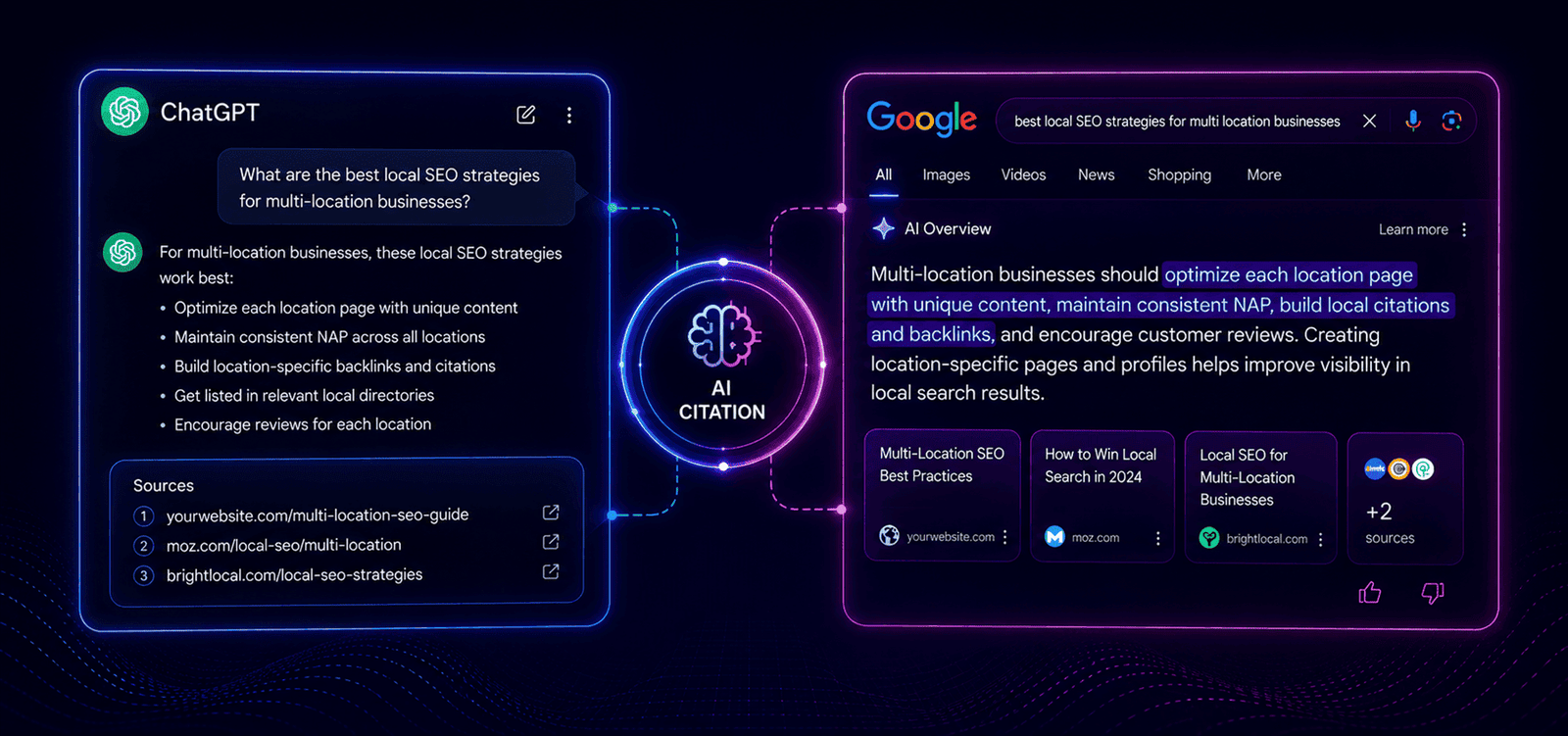

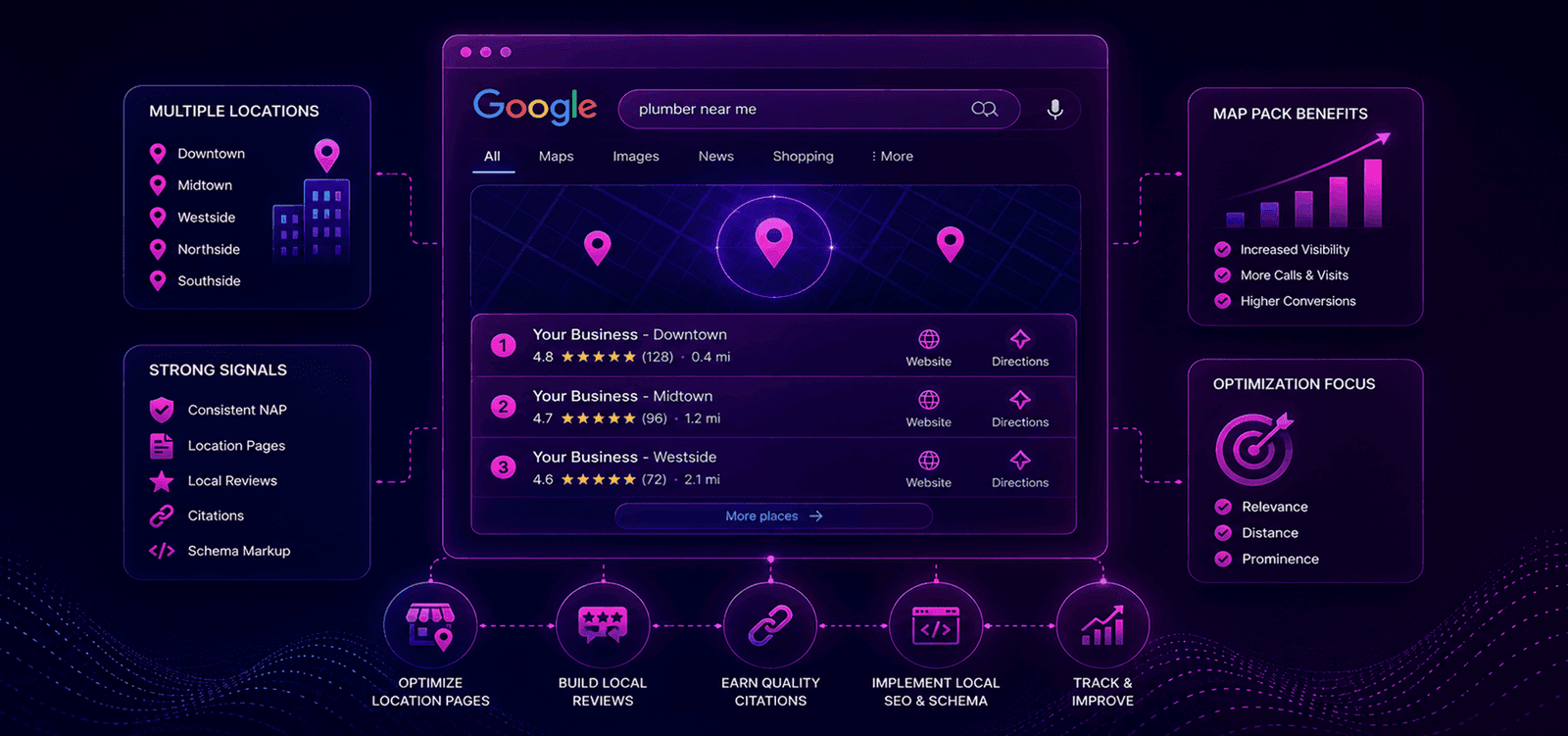
Multi-location local SEO breaks in a predictable way: a flagship location's map pack ranking pulls the resources and links while every other location page stays a thin, near-duplicate copy — so single-location competitors with far less brand authority end up outranking them. The fix is treating each location page as its own local entity, not one template repeated across cities.
The Multi-Location Problem
Local SEO rewards relevance to a specific place, not just brand authority. A large, trusted brand doesn't automatically transfer its reputation to every location it operates — Google evaluates each location largely on its own signals: its own Google Business Profile, its own citations, its own reviews, and its own dedicated page. Treat all locations as one undifferentiated brand, and most of them will lose to smaller, more locally-optimized competitors.
Building a Scalable Location-Page Template
The first fix was structural. Several locations either shared a generic "find a clinic near you" page or had no dedicated page at all. I built a single location-page template that could scale across all 22 sites while still containing genuinely unique, location-specific content: real staff bios, real service availability by site, embedded maps, and locally-relevant scheduling information — not just the city name swapped into a templated paragraph. That distinction is exactly what separates a page that ranks from one that doesn't, and it's the same discipline behind local SEO work generally.
Thin, duplicated location pages are one of the fastest ways to actively suppress local rankings, since search engines can detect templated content with near-zero unique value from miles away.
Local SEO for multi-location brands isn't one strategy repeated 22 times — it's 22 small local businesses that happen to share a name. — Richi Meckvan
Cleaning Up Citation Data
Citation audits across the 22 locations turned up hundreds of inconsistencies — old addresses from a prior office move, duplicate Google Business Profile listings created by different staff members over the years, and phone numbers that no longer matched what was listed on the website. Every inconsistency dilutes the trust signal Google uses to confirm a business is legitimately operating at a given address, so cleanup came before any new optimization work.
Systematizing Review Generation
Review volume and recency are a meaningful map-pack ranking factor, and they were wildly uneven across locations — some had 200+ reviews, others had fewer than ten. I implemented a simple automated review request triggered shortly after each appointment, standardized across every location so review growth stopped depending on which individual staff member happened to remember to ask.
The Results
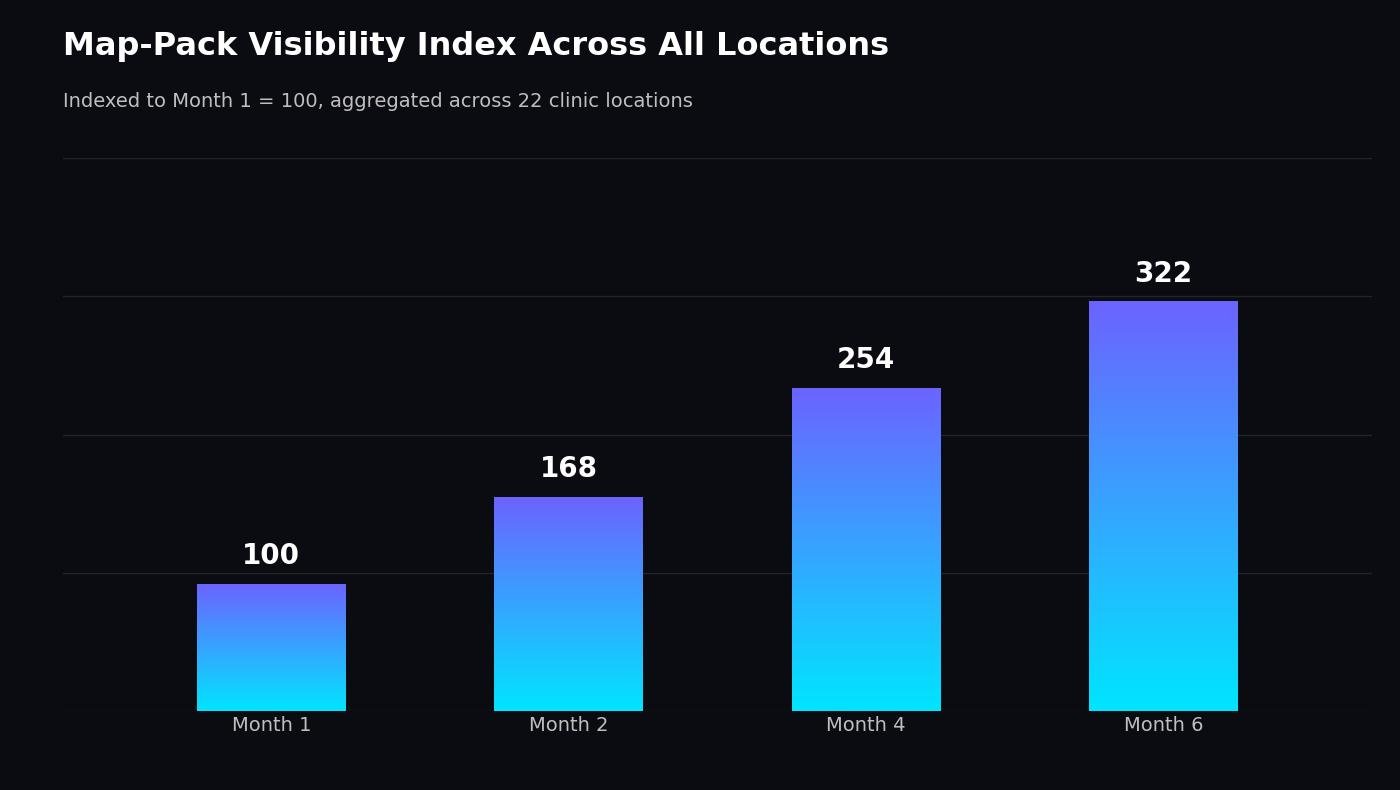
Six months in, aggregate map-pack visibility across all 22 locations had more than tripled, and the gap between the flagship location and the weakest-performing locations had narrowed significantly — the goal was never to make every location identical, but to stop the weakest ones from being invisible.
Key Takeaways
- Brand authority doesn't automatically transfer to every location — each one needs to earn its own local relevance signals.
- Templated, low-uniqueness location pages actively suppress rankings; genuine local specificity matters.
- Citation consistency is a prerequisite for local trust, not an optional cleanup task.
- Review generation needs to be systematized, not left to individual staff memory, especially past a handful of locations.
If some of your locations are thriving in the map pack while others are nearly invisible, that's almost always fixable — reach out and I'll show you where the gaps are. For a smaller-scale example of the same principle — one city, genuinely different pages per service instead of one template — see how the SEO, PPC and digital marketing pages on this site each cover Ahmedabad differently.