
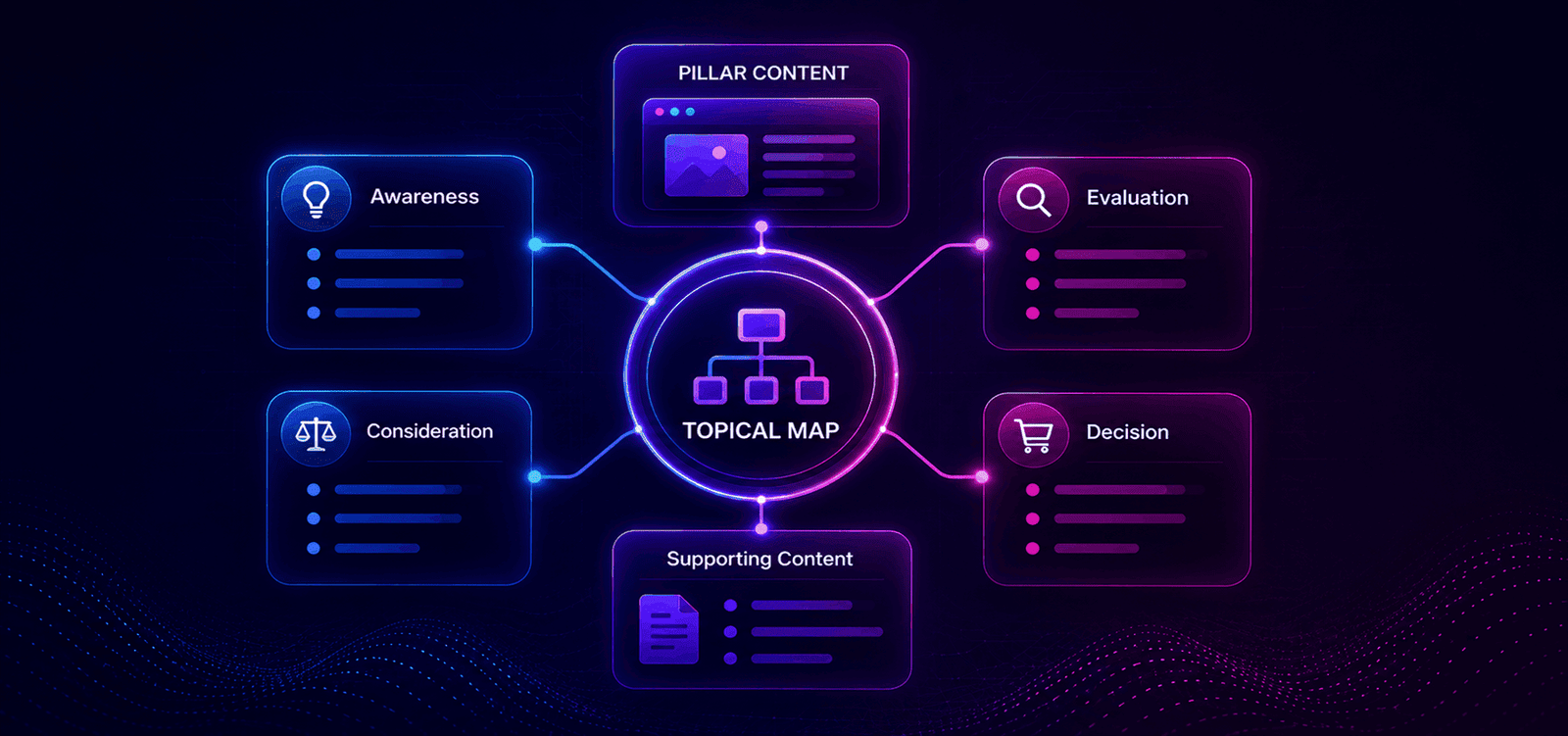
A topical map turns a keyword list into a content strategy: instead of 200 keywords producing 200 disconnected posts that each compete weakly on their own, the same keywords get organized around buyer intent so every page reinforces the ones around it. The keywords don't change — the structure connecting them does, and that structure is what builds topical authority.
A Keyword List Isn't a Content Strategy
Keyword research tells you what people search for. It says nothing about how those searches relate to each other, which ones represent someone just starting to research a problem versus someone ready to buy, or how a single piece of content could realistically rank for dozens of related variations instead of just one. A list optimizes for volume. A map optimizes for coverage and relevance — which is what search engines actually reward now.
What a Topical Map Actually Is
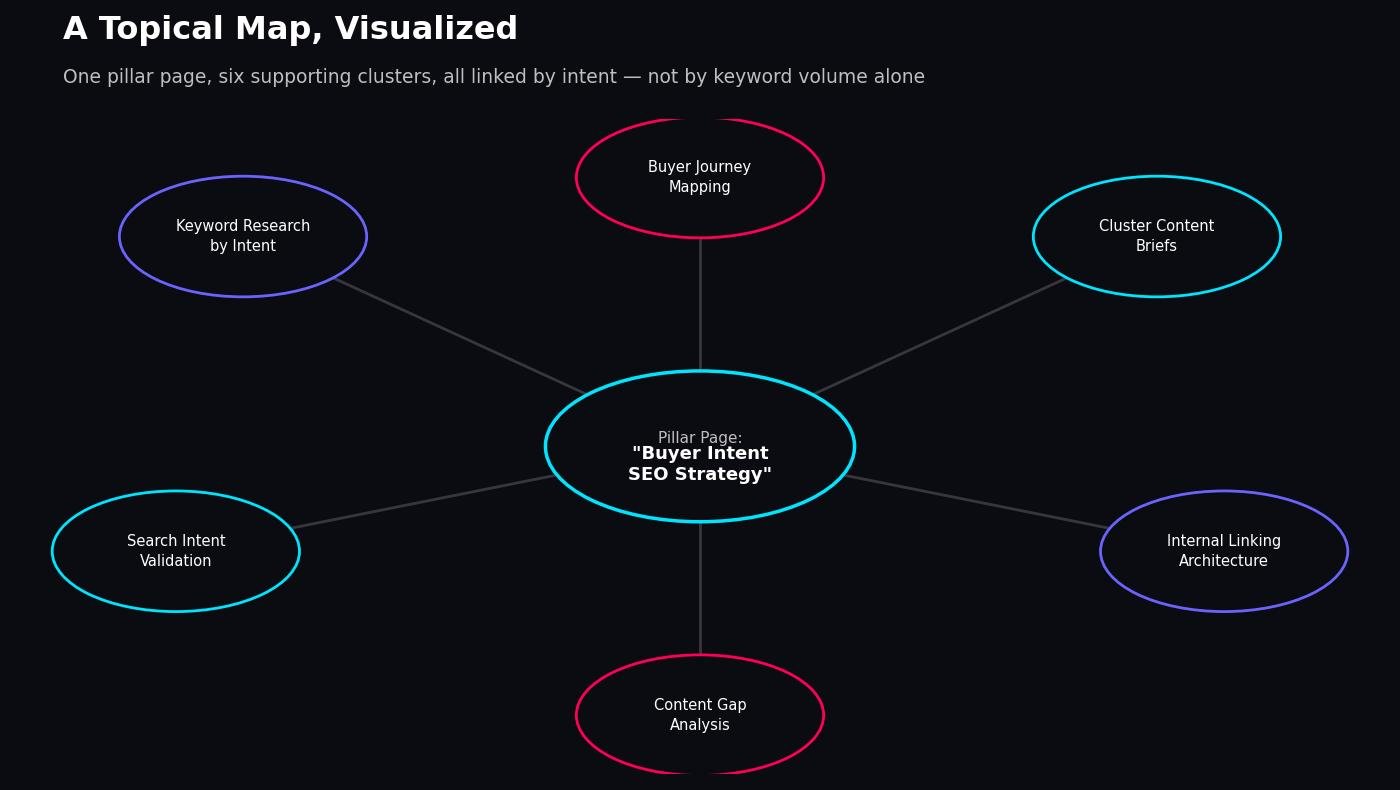
A topical map organizes content into a hub-and-spoke structure: one comprehensive pillar page covering a broad topic, surrounded by narrower cluster pages that each go deep on one specific subtopic or question, all linked back to the pillar and to each other where it makes sense.
Pillar Pages
The pillar page is the broad, authoritative overview — comprehensive enough to genuinely answer the top-level question, but not so deep on any single subtopic that it needs to duplicate what the cluster pages will cover. Think of it as the table of contents for everything you know about a subject.
Cluster Content
Cluster pages go narrow and deep. Each one targets a specific question, sub-intent, or long-tail variation that the pillar page only mentions in passing. Done well, a single pillar with six or seven strong clusters can realistically rank for hundreds of related search terms, because the linking structure signals topical depth that no standalone page could achieve on its own.
A topical map isn't a content calendar. It's an argument to Google that you understand a subject completely, not just one keyword within it. — Richi Meckvan
Building a Topical Map, Step by Step
- Pick one core service or product area and define the single broad question your pillar page needs to answer.
- Cluster your keyword research around sub-intents — questions, comparisons, and use cases that naturally branch off the pillar topic.
- Validate each cluster against real search intent, not just volume — a high-volume keyword with the wrong intent will never convert well regardless of ranking.
- Write briefs for each cluster page that explicitly reference the pillar and at least two sibling clusters, so linking is planned before writing starts, not bolted on afterward.
- Identify and fill content gaps last — once the map exists, gaps become obvious rather than something you have to guess at.
Linking It All Together
The linking structure is what makes a topical map function as a system rather than just a folder of related articles. Every cluster page should link up to the pillar, and pillar pages should link down to every cluster — but the highest-value links are often the lateral ones between clusters that share a sub-intent, since those are the connections that most directly demonstrate topical depth to both users and search engines, and they directly support the extractability signals that get content cited inside ChatGPT and AI Overviews.
Key Takeaways
- A keyword list tells you what to write about; a topical map tells you how it all fits together.
- Pillar pages go broad, cluster pages go deep — neither should try to do the other's job.
- Plan internal linking at the brief stage, not after the content is already published.
- Content gaps are far easier to spot once you can see the whole map, not just a list of individual keywords.
If your content calendar feels like a list of disconnected topics rather than a strategy, that's usually a missing topical map — reach out and I'll help you build one. You can see one built around a single service in practice on the SEO consultant in Ahmedabad page — it's the pillar; the blog posts linked from it are the clusters.