
The quick answer
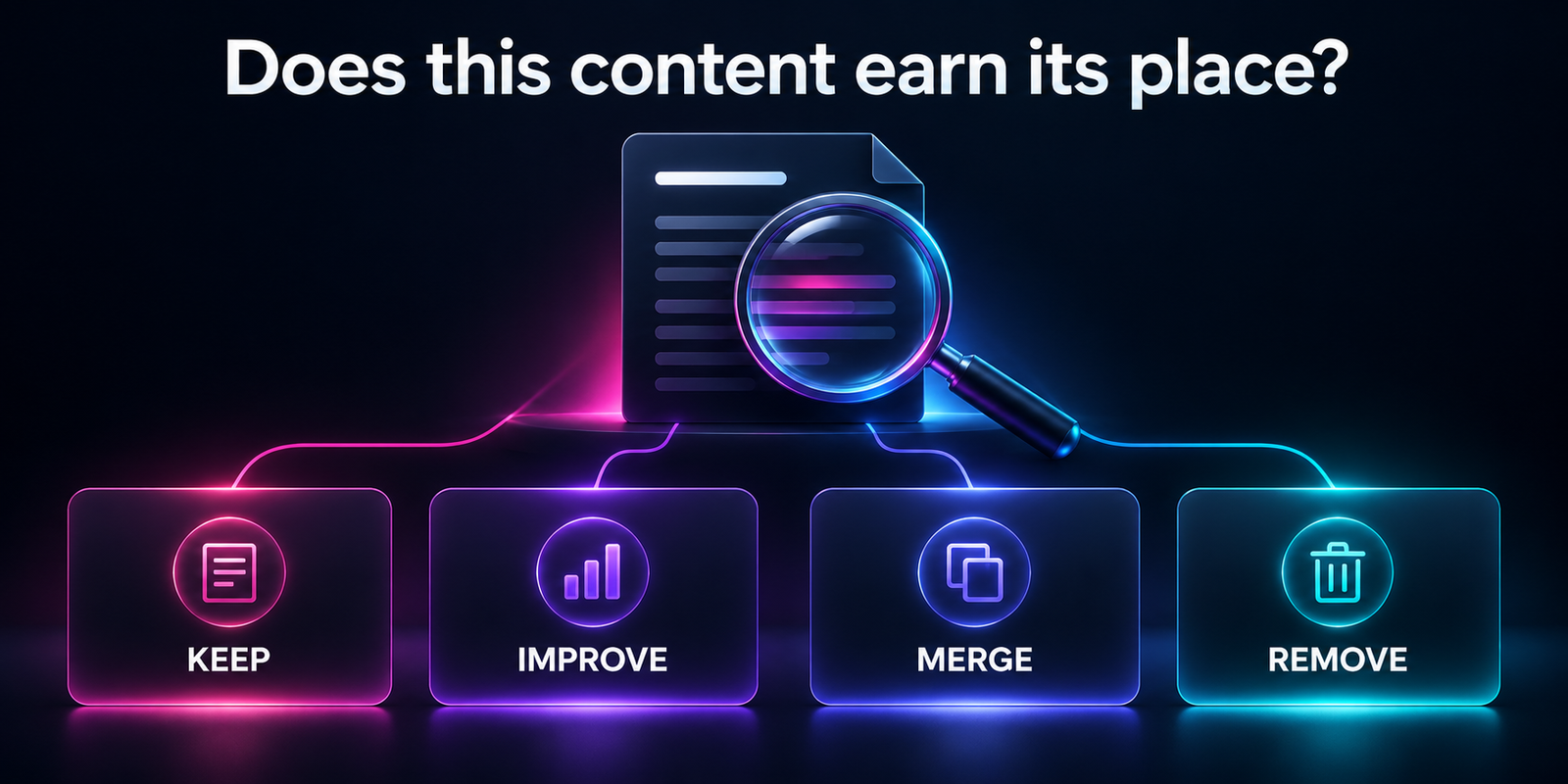
Audit AI-generated content by its usefulness, accuracy and role in your website. Keep pages that serve a clear need, improve pages with fixable gaps, merge pages serving the same need, and remove content that no longer has a useful purpose.
Do not use an AI-detector score or a traffic threshold as the final decision. Check what the page contributes before changing its URL or deleting it.
You have published quickly, but the blog now repeats itself. Some posts earn visits without enquiries. Others describe features your product no longer offers. Editing the opening paragraph will not resolve those problems.
A content audit should produce decisions your team can act on. The method below starts with evidence, then separates writing problems from technical issues and missing buyer information.
Jump to a section
What makes AI-assisted content worth keeping?
The useful question is what the reader gains from the page. A polished article can still be vague, inaccurate or unnecessary. A short guide can be valuable if it solves a specific task well.
Google's guidance on generative AI content focuses on accuracy, relevance and added value. It warns against generating many pages without helping users. Treat the audit as a review of the finished work, including titles, descriptions and image text.
Write down the reader's task in one sentence. Then identify the passage, process or resource that completes it. If you cannot find one, record a concrete gap rather than simply marking the page “low quality.”
Build an inventory that supports decisions
List each URL with its topic, intended reader, publication date, last meaningful review, owner and business purpose. Add indexing status, relevant visits, useful actions and known links from other websites where available.
Group posts by the task they serve, not just a shared keyword. A beginner explanation and an implementation checklist can cover the same subject while serving different needs.
- High-risk facts: review pricing, product limits and time-sensitive instructions first.
- Important pages: prioritise content linked from sales journeys or used by support teams.
- Repeated topics: compare overlapping pages side by side.
- Unseen content: check discovery and indexing before blaming the writing.
Use enough history to account for seasonality and a realistic buying cycle. A recently published post has not had the same opportunity as an established guide. The indexing checklist helps separate missing visibility from weak content.
Review claims, usefulness and the next step
Check the statements that could mislead a buyer
Trace product claims to current documentation or an accountable product owner. Open cited sources and confirm they support the exact statement. A working link is not proof that the cited finding says what your article claims.
Remove invented experience, unsupported customer results and references you cannot verify. If a claim matters but evidence is missing, replace it with a narrower, accurate explanation or get the evidence before publishing it again.
Test whether the instructions work
Follow the steps in a clean session. Check missing prerequisites, changed menus, permissions and failure states. Replace “simply connect the tool” with the details a reader needs to make that connection.
For advice articles, ask what choice the reader can make after reading. A list of benefits with no limits or trade-offs rarely helps someone choose.
Check the route to a useful action
Does the next link match the reader's stage? A technical tutorial may need a setup guide before a demo invitation. A comparison page may need plan details. Review the traffic-to-demo guide when visits are healthy but buyers stop progressing.
When should you keep, improve, merge or remove?
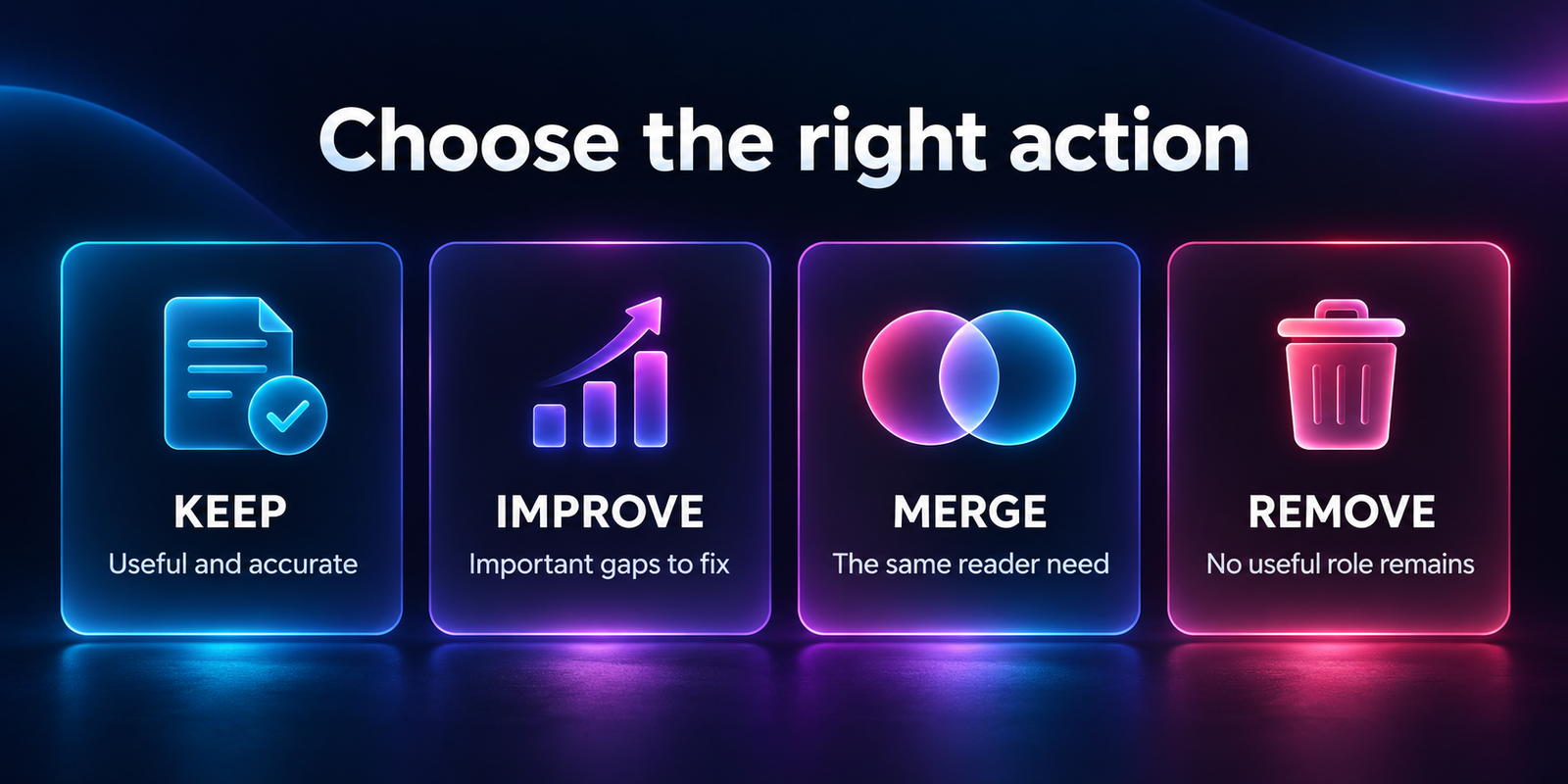
| Decision | Evidence to look for | Next action |
|---|---|---|
| Keep | A distinct task, accurate detail and a useful role | Retain the URL and assign a future review |
| Improve | The task matters, but answers or instructions are incomplete | Write a specific revision brief |
| Merge | Several pages serve substantially the same purpose | Choose one destination and preserve useful detail |
| Remove | No useful purpose remains and there is no suitable content to preserve | Plan removal and repair affected links |
Keep does not mean “never touch again.” A useful low-traffic support article may deserve to stay. Record why it matters so the next audit does not restart the same argument.
Improve needs a brief, not a request to “humanise” the text. Specify the unanswered question, inaccurate claim, missing workflow and relevant next link. Replacing familiar words with synonyms does not add value.
Merge needs a destination chosen on evidence. Review relevance, existing links, visibility and the quality of the current page. Preserve useful sections from the others, then use redirects only where the replacement truly serves the old page's purpose.
Remove is a content decision, not a traffic shortcut. Check customer use, referral visits and internal links first. If there is no relevant replacement, an appropriate not-found response is more honest than sending every removed article to the homepage.
How do you identify overlap without merging too much?
Compare the question, audience and expected outcome across the pages. Similar wording alone is weak evidence. Two pages may deserve to coexist if one explains a concept and the other helps a reader implement it.
Check which URLs appear for the same relevant queries over time. A page switching in search is a clue to investigate, not automatic proof of harmful competition. Review the actual content before choosing a merge.
Map each retained page to a distinct role and link between related tasks. The buyer-intent content guide helps build that structure. If the overlap comes from a shared page generator, review the programmatic SEO process as well.
Release changes in batches you can verify
Keep a change log before editing. Record the original URL, decision, replacement if any, owner and release date. Save the previous content so an accidental loss can be recovered.
- Correct material inaccuracies promptly.
- Revise a manageable group with a shared problem.
- Check titles, headings, links and structured data against the revised page.
- Test redirects, sitemap entries and final destinations after merges.
- Review indexing, relevant visits and useful actions over a suitable period.
Do not change every page and then assume any site-wide movement proves the audit worked. Track affected groups separately and note campaigns, seasonality and technical releases that could influence the result.
Google's helpful-content questions provide another editorial check. Your own review still needs specific product knowledge and evidence; a checklist cannot verify facts on its own.
Common questions
Should I delete every post written with AI?
No. Review the final content. Keep accurate, useful pages with a clear purpose and fix the ones that fail that test.
Does zero traffic mean a page should go?
No. Check age, indexing, demand, customer use and its role in the buying journey. Low traffic alone does not establish that a page is useless.
Should I change the date after a small wording edit?
Do not use date changes to imply a full review that did not happen. Keep your dates consistent with the actual work completed.
Can rewriting guarantee rankings or AI citations?
No. Judge the revision first by accuracy and usefulness, then monitor visibility and business outcomes. Neither rankings nor citations are guaranteed.
Written by Richi Meckvan. Updated on 2 October 2026.