

The quick answer
Programmatic SEO works when a reusable template turns reliable data into genuinely useful pages. It stops adding value when new URLs repeat the same answer, describe unsupported products or exist only to cover keyword variations.
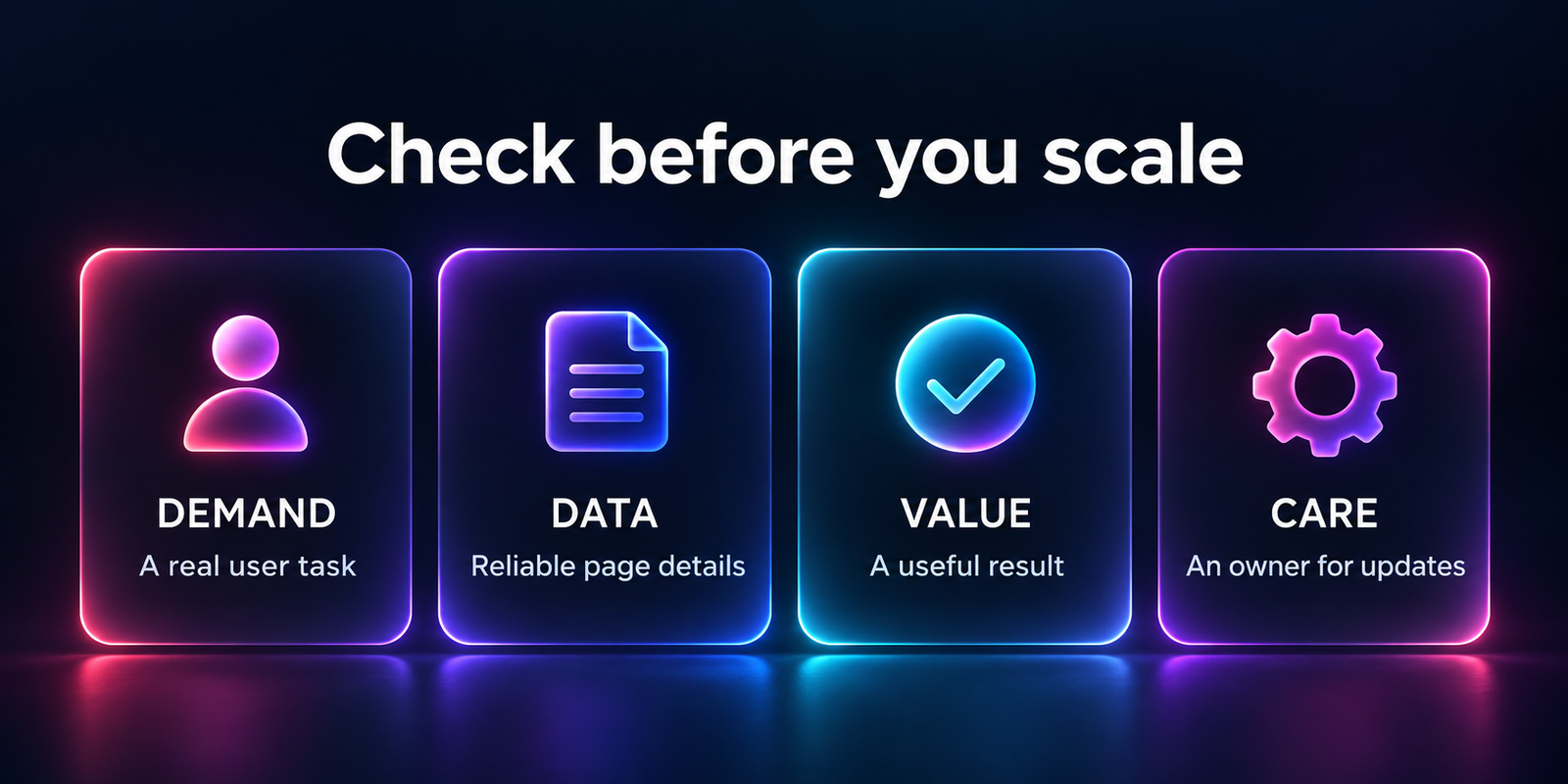
Validate a small group before expanding. Check demand, data quality, page usefulness and maintenance together. A large publishing target is not a strategy.
Your SaaS team can generate hundreds of integration, template or use-case pages. The technical work may be straightforward. The harder question is whether each page gives someone a reason to visit and stay.
This guide helps you decide what deserves its own URL, how to test the first release and when to pause expansion.
Jump to a section
What is programmatic SEO for SaaS?
It is a way to create and maintain related pages using a shared structure and a data source. The content may include supported integrations, available templates, product comparisons or other repeatable information.
The template handles the layout. The data should supply the differences that matter to readers. Changing only a product name, location or keyword leaves the core question unanswered: why should this page exist separately?
Google's scaled-content policy targets producing many pages primarily to manipulate rankings without helping users. The risk comes from purpose and value, not simply from using a template.
Does each page group serve a real task?
Start with the task your reader is trying to complete. An integration page should explain a supported connection. A template page should help someone choose and use a real template. A comparison should help someone decide between relevant options.
Review search results, customer requests and your existing product usage. Low reported keyword volume does not automatically mean no demand, but a long keyword list does not prove demand either.
- Distinct need: does this variation change the answer or workflow?
- Product fit: can your product genuinely help with that task?
- Useful destination: can a reader act on the information or access the promised resource?
- Appropriate page type: would one filterable directory serve the need better than separate pages?
Use the buyer-intent framework before turning every query into a URL. It helps separate topic coverage from unnecessary page multiplication.
Is the underlying data reliable enough to publish?
A strong template cannot repair weak source data. Define the required fields and who owns them before building the generator.
For integration pages, those fields might include supported actions, direction of data flow, required plans, setup steps and known limits. “Works with this tool” is too vague if the connection actually requires a third-party service.
Decide what happens when a field is missing
Do not let blank values become confident claims. Hold the page back, omit a genuinely optional section or explain the limitation accurately. Required product facts should block publication until confirmed.
Record a source and review owner for changing facts. If an upstream provider changes its pricing or API, identify which pages rely on that information. Maintenance should be planned before the first large release.
Can the page help someone without sending them elsewhere?
Test the page with the product name covered. If the remaining text fits every page equally well, the useful detail may be missing.
| Page type | Useful detail to include | Warning sign |
|---|---|---|
| Integration | Supported actions, setup, limits and requirements | Connection implied but not available |
| Template | Preview, intended task, inputs and how to use it | The promised resource does not exist |
| Use case | A specific workflow and product fit | Only the job title changes |
| Comparison | Current, balanced differences that affect the choice | Unsupported claims that your product wins everything |
Shared navigation and repeated setup notes are normal. The goal is not a certain percentage of unique words. It is a useful answer to the distinct task.
Check whether headings, descriptions and structured data reflect the actual page. A template bug can publish the same incorrect statement everywhere. The content-audit guide explains how to review the finished output.
Which technical checks belong before launch?
Open a selection of routes directly, including pages with long names, missing optional data and unusual characters. Check the initial and rendered content, response status, page title and canonical URL.
- Use stable URLs and real internal links from relevant directories.
- Keep tracking parameters and filter combinations from creating uncontrolled duplicate destinations.
- Confirm that each intended page has the right canonical, rather than inheriting the directory's URL.
- Make sitemap entries agree with the public, preferred URLs.
- Check that missing resources do not display a generic success page with an empty heading.
Google's canonical guidance explains how consistent signals help identify preferred versions. A canonical is not a repair for a page that should never have been published.
Do not canonicalise genuinely different integrations to one broad page simply because they share a design. If pages are not being selected for search, use the indexing checklist to identify the actual failure.
How do you judge the first release?
Choose a small group that includes different data conditions, not only the strongest pages. Include straightforward and complex workflows so the review can expose weaknesses in the template.
Before release, agree what would justify expansion. Record whether the pages load correctly, answer the task, receive relevant discovery and help users reach a useful action. Give new pages time to be crawled and evaluated.
Review results by page type and publication group. A few strong pages can hide a large set with no distinctive value. Conversely, low early traffic does not prove a technical failure.
The SEO measurement guide helps connect discovery with useful actions. Track qualified outcomes rather than treating indexed-page count as the business result.
When should you pause expansion?
Pause when required facts are unreliable, errors recur across the template or new variations no longer change the answer. Repair the publishing system before adding more URLs.
If only one page group fails, compare it with the groups that work. Check audience fit, data depth, internal links and product usefulness. Do not rewrite the whole site based on one weak group.
- Identify the repeated failure and affected URLs.
- Fix the data source or shared template.
- Recheck existing pages before publishing more.
- Merge true duplicates where a relevant replacement exists.
- Assign a regular review for availability, accuracy and broken workflows.
Also account for maintenance cost. A page that takes little time to generate can still require ongoing review, support and engineering work. Scale the part that is useful and sustainable.
Common questions
Is programmatic SEO the same as AI writing?
No. Programmatic publishing uses structured data and templates. AI may help with some content, but it does not replace verified product facts or editorial review.
How many pages should I launch?
Start with a group your team can review fully and maintain. Expand when the evidence supports it, rather than choosing a large number first.
Does every page need completely different wording?
No. Shared structure is fine. Each page needs meaningful information for its own task, not artificial wording changes.
Should I delete every page that gets no clicks?
No. Check indexing, age, demand and usefulness first. Choose improvement, consolidation or removal based on the page's role.
Written by Richi Meckvan. Updated on 3 October 2026.