
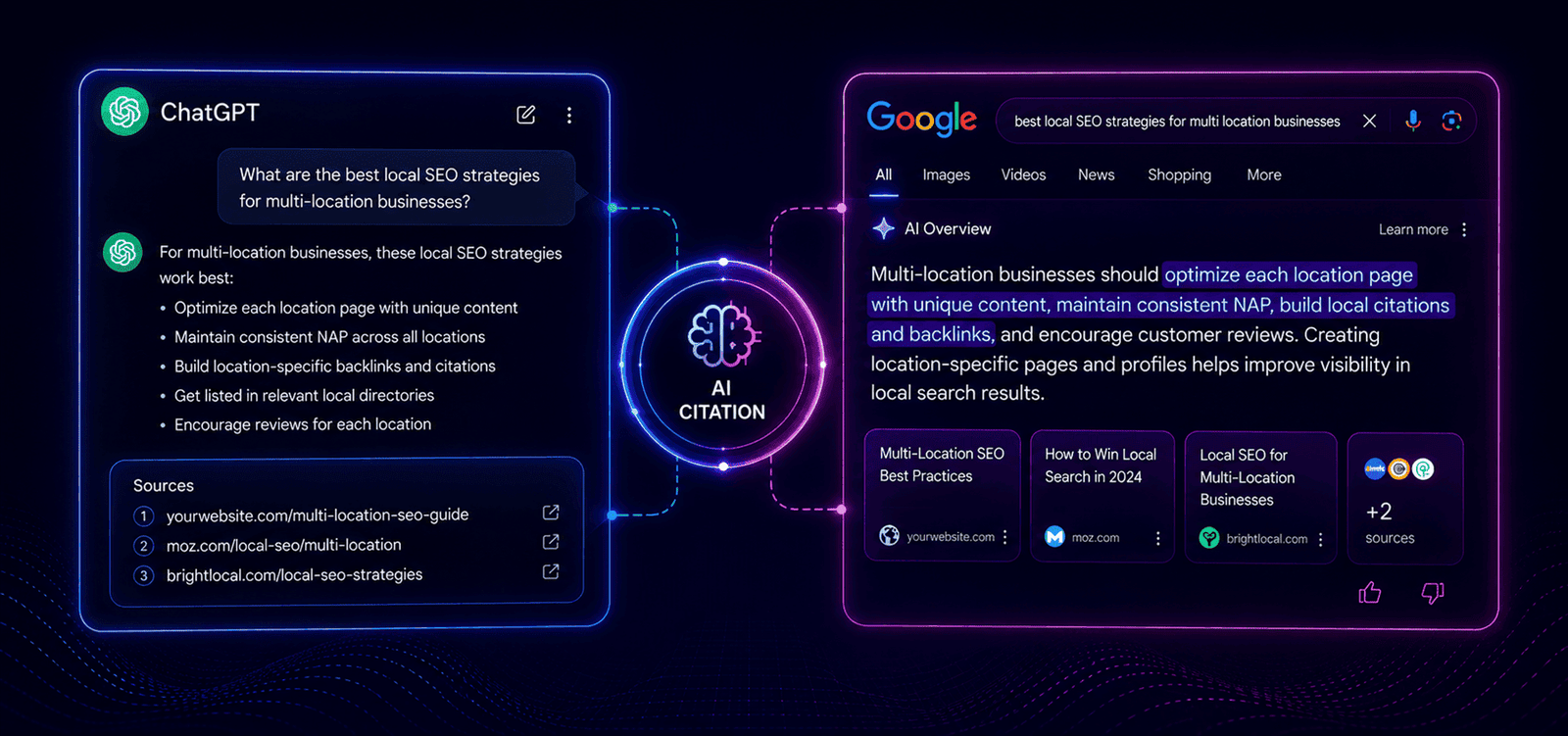
Getting cited inside ChatGPT, Perplexity and Google's AI Overviews follows learnable patterns, not luck: clear, quotable answers near the top of a page, named statistics and sources, comparison tables, and content that states things definitively instead of hedging. These are the same signals that made classic SEO learnable once enough ranking pages got studied.
Why Citation Is the New Ranking
When an AI assistant answers a question directly, the user often never clicks through to a source at all — but when it does cite or link to a source, that citation functions like a hybrid of a ranking position and a testimonial. You're not just visible; you're the source the AI trusted enough to attribute. For a growing share of queries, that citation is worth more than a page-one ranking that nobody scrolls down to click.
How AI Systems Choose What to Cite
Extractability
AI systems retrieve and synthesize information far more easily from content that's structured as clear, self-contained question-answer pairs than from content buried in long, meandering paragraphs. A page can be well-written and still be hard for a retrieval system to extract a clean answer from — clarity of structure matters as much as clarity of writing.
Trust Signals
Author expertise, consistent bylines, and being cited or mentioned across multiple independent sources all function as trust signals that make a generative system more confident in surfacing your content as a source. This is where AEO and traditional E-E-A-T practices overlap almost completely — building real topical authority helps both disciplines at once.
AI systems don't reward the best-written page. They reward the page that's easiest to extract a confident, correct answer from. — Richi Meckvan
The Content Changes That Actually Move the Needle
Most of the work isn't a rewrite — it's restructuring content that's already reasonably good so it's easier for a retrieval system to pull a clean, accurate answer from it.
| Change | Why It Helps |
|---|---|
| Answer the question in the first 2–3 sentences | Gives retrieval systems a clean, extractable answer before context or caveats |
| Add FAQ and HowTo structured data | Gives machines an explicit, machine-readable question-answer structure |
| Use clear, descriptive subheadings | Makes it easy to isolate the exact section relevant to a specific query |
| Include a visible author byline and credentials | Strengthens the trust signal that increases citation confidence |
| Keep facts and figures current | Generative systems weight recency heavily when multiple sources conflict |
None of this works if the underlying content is still organized as a random list of keywords rather than a connected structure — see Topical Maps 101 if your content calendar still reads that way.
Measuring Whether It's Working
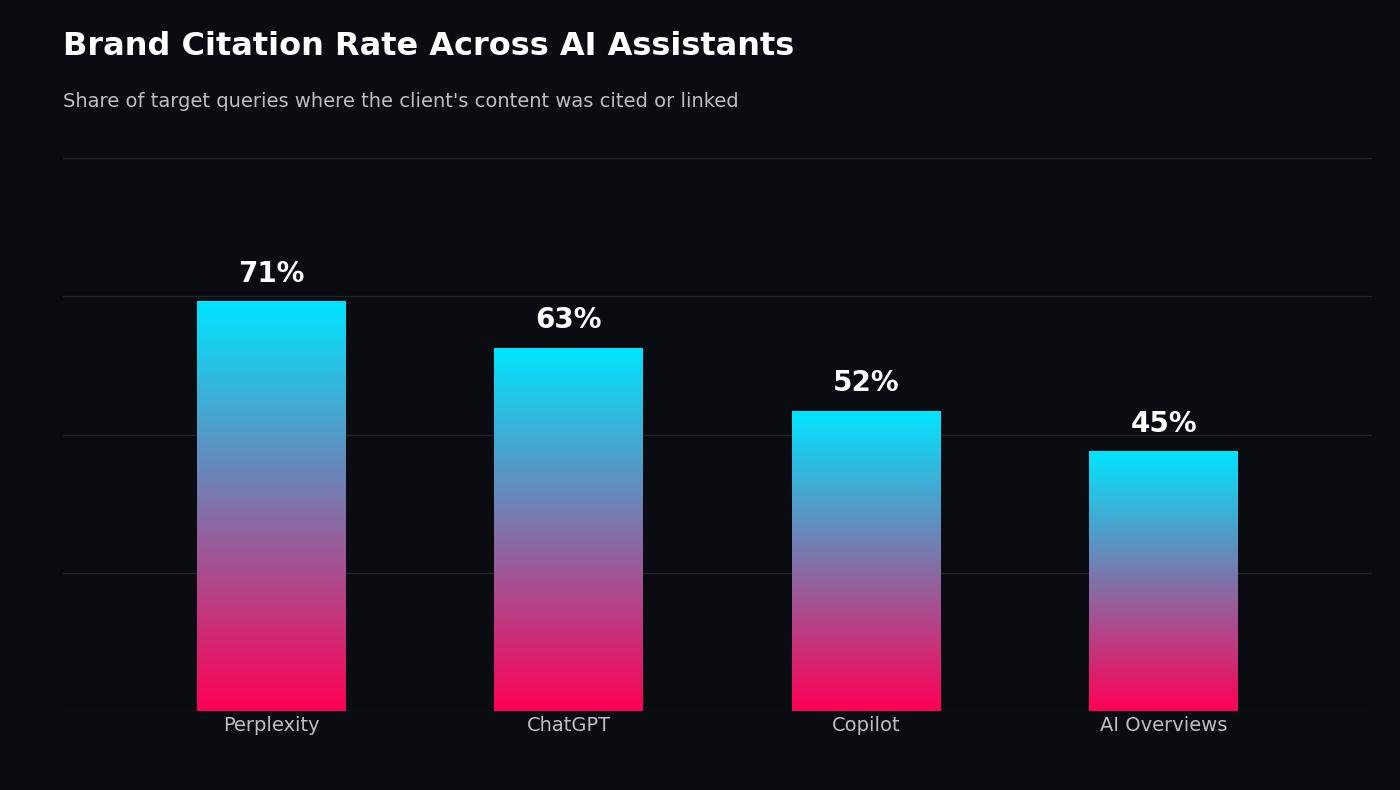
Rank tracking tools weren't built for this, so measurement has to be manual and deliberate: run a consistent set of target queries across ChatGPT, Perplexity, Copilot and Google's AI Overviews on a regular cadence, and log whether your brand is mentioned, cited with a link, or absent entirely. It's tedious compared to automated rank tracking, but it's currently the most reliable way to see whether restructuring work is actually paying off.
Key Takeaways
- Citation inside an AI answer is a stronger signal than a ranking nobody scrolls to click — treat it as its own KPI.
- Structure content so a machine can extract a clean answer in the first few sentences, not just so a human can skim it.
- Author credibility and structured data both meaningfully increase citation likelihood.
- Track citation frequency manually across each AI assistant — the tooling to automate this well doesn't fully exist yet.
If you don't know whether your brand shows up inside AI-generated answers yet, that's worth finding out before a competitor does — reach out and I'll run the check for you. This sits inside a wider shift worth understanding too — why every SEO roadmap needs an AI-search line item now.