
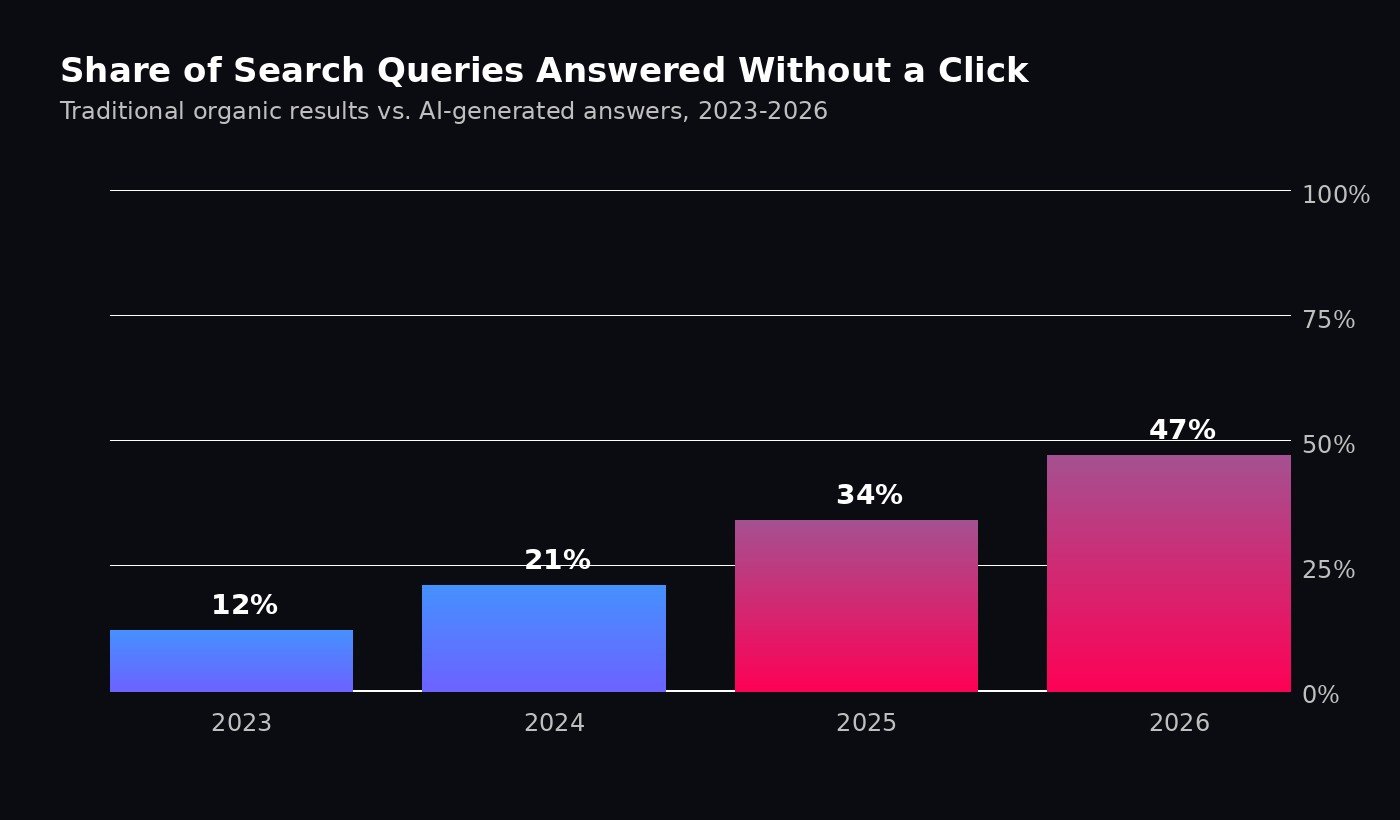
Your SEO roadmap needs a dedicated AI-search line item because a growing share of queries never produce a click anymore — AI Overviews, ChatGPT search, Perplexity and Copilot now answer directly, often using your own content as the source material without sending you the visitor. A roadmap that only tracks blue-link rankings is already missing where the traffic actually went.
This isn't a call to abandon traditional SEO. It's a call to widen the definition of "visibility" before your competitors do.
What Changed in Search
For two decades, ranking well meant one thing: showing up in the ten blue links, ideally near the top. That's no longer the whole picture. Search engines and AI assistants increasingly synthesize an answer from multiple sources and present it directly to the user — your brand might be the source, but the click never happens.
From Ten Blue Links to Answers
Google's own Search Central documentation has steadily expanded to cover structured data, E-E-A-T signals, and how content gets surfaced in AI-generated overviews. That expansion mirrors a real shift in user behavior: people increasingly phrase searches as full questions and expect a synthesized answer, not a list of links to sort through themselves.
Where AEO and GEO Fit In
Answer Engine Optimization (AEO) and Generative Engine Optimization (GEO) are the emerging disciplines around this shift. Rather than optimizing purely for rankings, they optimize for citability — the likelihood that an AI system will pull your content into its answer and, ideally, attribute it to you.
The goal is no longer just to rank — it's to be the source an AI trusts enough to quote. — Richi Meckvan
Auditing Your Current Visibility
Before changing anything, it helps to see how the two worlds actually differ in what they reward. The table below summarizes the signals I check first in any AEO/GEO audit, alongside their traditional SEO counterpart.
| Signal | Traditional SEO | AI Search (AEO / GEO) |
|---|---|---|
| Content structure | Headings & keyword placement | Clear, extractable question-answer pairs |
| Authority signal | Backlinks & domain authority | Consistent citation across the web + author expertise |
| Freshness | Update cadence for rankings | Recency weighting in generative retrieval |
| Structured data | Rich results eligibility | Machine-readable context for LLM ingestion |
| Success metric | Position & organic clicks | Citation frequency & brand mention share |
The data below is from an aggregate view across client accounts I manage — it's a directional trend, not a universal constant, but the direction is consistent across every industry I track.
Practical Steps to Take This Quarter
You don't need to rebuild your entire content strategy overnight. Start with these, roughly in order:
- Audit your 20 highest-traffic pages for whether they answer their target question in the first 2–3 sentences.
- Add or clean up structured data (Article, FAQ, HowTo schema) so machines can parse your content's structure.
- Build or strengthen an author/expertise signal — bios, credentials, and consistent bylines matter more here than in classic SEO.
- Track brand mentions inside ChatGPT, Perplexity and AI Overviews monthly, not just rank tracking — see how to get cited inside ChatGPT and AI Overviews for the specific content changes that move this number.
- Keep publishing depth content — AI systems still need a primary source to cite, and that source has to exist somewhere.
Key Takeaways
- Traditional SEO and AEO/GEO aren't competing disciplines — they share most of the same foundation.
- Citability is becoming as important as rankability.
- The businesses that adapt their content structure now will have a real head start once AI search becomes the default for their category.
If you're not sure where your brand currently stands across both traditional and AI search, that's exactly the kind of audit I run for new clients — reach out and I'll walk you through what I find. Want to run a first pass yourself? Here's how I set Claude up to help with exactly this.